
At a glance
The short answer: lower the radiator setting, not the room temperature
Boiler flow temperature is the temperature of the water leaving the boiler for the radiators. On a modern condensing boiler, lowering it can reduce the temperature of the water returning to the boiler, helping the appliance recover more heat from its exhaust gases instead of wasting it. Energy Saving Trust says research found that turning a boiler flow temperature down to 60°C improves efficiency by nearly 4%.
For a combi boiler with no hot-water cylinder, 60°C is a sensible first setting for the radiator circuit. It does not have to be the final answer: the lowest setting that still warms the home adequately is the useful one. For a conventional or system boiler that also heats a cylinder, Energy Saving Trust says not to set the single boiler flow control below 65°C because the stored hot water needs to reach a safe temperature.
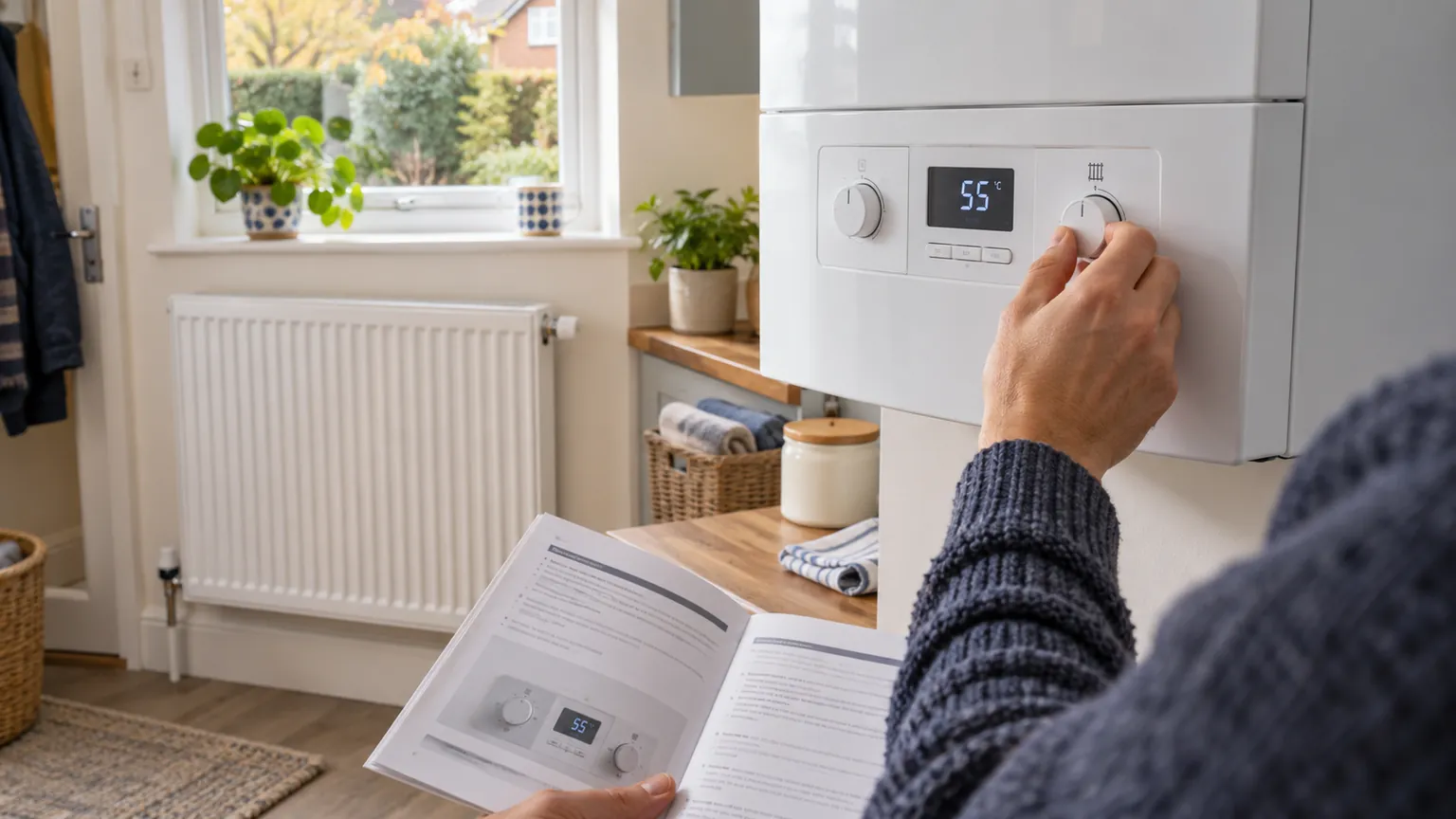
This is a user-control adjustment, not gas work. Take a photograph of the original setting, use the manufacturer’s instructions and change only the clearly identified radiator or central-heating control. Do not remove the boiler case or touch gas, combustion or installer settings.
First identify your boiler and controls
A combi boiler normally provides heating and hot water directly and has no separate hot-water cylinder. Its panel commonly has two temperature controls: a radiator symbol for central heating and a tap symbol for hot water. The radiator control is the one relevant to this guide.
A conventional or system boiler usually works with a hot-water cylinder, often found in an airing cupboard. It may have one boiler temperature setting serving both space heating and the cylinder. If you have a cylinder, a thermal store, underfloor heating, weather compensation or controls you cannot identify, check the manual or ask the installer who services the system before changing anything.
The boiler flow control is not the room thermostat. The room thermostat decides when the heating should run according to the room temperature. The flow setting decides how hot the water sent to the radiators can become. Thermostatic radiator valves then limit individual rooms. Get those normal heating controls working sensibly before trying to fine-tune the boiler.
| System | What to look for | Practical starting point |
|---|---|---|
| Combi, no cylinder | Separate radiator and tap controls | Try 60°C on the radiator control |
| System or conventional, with cylinder | Cylinder plus one shared boiler setting | Do not go below 65°C without expert advice |
| Unclear or specialist system | Thermal store, underfloor heating or unfamiliar controls | Use the manual or ask a competent engineer |
These are starting points, not a substitute for the appliance manual or system-specific commissioning settings.
Why a lower flow temperature can use less gas
Water loses heat as it passes through the radiators and returns to the boiler. A condensing boiler becomes more efficient when that return water is cool enough for water vapour in the flue gases to condense, releasing heat that would otherwise leave through the flue. Lowering the flow temperature generally lowers the return temperature too.
The trade-off is speed. Cooler radiators give out heat more slowly, so the home can take longer to warm. That does not mean the setting has failed: a boiler running steadily at a lower temperature can be more efficient than one repeatedly producing very hot water. But if the home cannot reach a safe, comfortable room temperature during cold weather, increase the flow setting in small steps.
Savings vary with the boiler, radiator size, insulation, weather and previous setting. A percentage from a study is not a guaranteed reduction on the whole gas bill because gas may also heat water, and the standing charge does not change. Measure your own kWh rather than treating a headline cash figure as a promise.
How to adjust a combi boiler safely
Start when the heating works normally and nobody vulnerable will be put at risk by a slower warm-up. Photograph the panel, find the radiator symbol in the manual and note the current temperature. If the display shows a number only while you turn the control, that is usually the target rather than the room temperature.
Set the radiator flow to 60°C, then leave the hot-water control unchanged. Run the heating on its usual schedule for several days. Check whether the coldest occupied room reaches its normal thermostat setting and whether every radiator heats properly. If the home remains comfortable, you can try a 5°C lower step; if it warms too slowly, move back up by 5°C.
Cold weather may require a higher setting than mild autumn weather. Keep the room thermostat at a safe, comfortable level, and take extra care in homes with older people, children under five or anyone whose health is affected by cold. GOV.UK specifically advises these groups to make sure the home remains warm enough when trying a lower combi flow temperature.
- Change one control: the radiator flow temperature, not the tap temperature or room thermostat.
- Make small changes: 5°C steps make it easier to see what works.
- Keep a return point: the photograph lets you restore the previous setting.
- Stop if there is a fault: error codes, pressure loss, unusual smells or poor heating need proper diagnosis.
Why a hot-water cylinder changes the advice
With a conventional boiler and a cylinder, the same heated water may be responsible for raising the stored domestic hot water to its target temperature. Energy Saving Trust recommends trying 65°C but says not to set the boiler flow below that level, because the system must still heat the cylinder safely.
HSE guidance explains the underlying risk: legionella bacteria multiply most readily between 20°C and 45°C, while hot water stored at 60°C or higher is used as a temperature-control measure. Do not confuse a cylinder thermostat with the boiler’s flow setting, and do not reduce either based on combi-boiler advice.
Some installations have separate heating and cylinder controls, mixing valves or automated weather compensation. Those systems may achieve efficient radiator temperatures while keeping stored water safe, but their configuration is system-specific. Ask a competent heating engineer to explain the controls rather than guessing.
Check the result with meter readings, not guesswork
Record a gas meter reading before the change and again after a week. Note the outdoor weather, heating hours and any unusual hot-water use. A fair comparison needs a similar period; a colder week can use more gas even when the boiler is operating more efficiently.
Suppose a like-for-like comparison shows 250 kWh less gas used. At the current Great Britain average capped Direct Debit gas rate of 7.97p/kWh for 1 October to 31 December 2026, the usage difference is 250 × £0.0797 = £19.93. The standing charge is unchanged, and your own tariff may have a different unit rate. This example shows how to value a measured difference; it does not predict the saving from changing one control.
Use actual kWh from the bill where possible. If you only have meter readings, the gas units to kWh guide explains the conversion, and the gas bill calculator can estimate the cost between two readings. Our boiler running-cost guide explains why input, output and real consumption are different.
| Figure | Calculation | Result |
|---|---|---|
| Measured difference | Example comparison | 250 kWh |
| Illustrative unit rate | Ofgem GB average, Oct–Dec 2026 | 7.97p/kWh |
| Usage-cost difference | 250 × £0.0797 | £19.93 |
| Standing charge | Same number of account days | No change |
Use the unit rate on your tariff. Weather and hot-water use must be considered before attributing a difference to the flow setting.
When to stop and get professional help
Do not remove the case, adjust combustion settings, alter pipework or try to repair a boiler. HSE says anyone employed to work on domestic gas appliances must be Gas Safe registered and competent for that work. Regular servicing also gives you a good opportunity to ask whether the controls and radiator balancing suit lower-temperature operation.
If you suspect an appliance is unsafe, turn it off and do not use it until it has been checked. If you suspect a gas leak in Great Britain, call the National Gas Emergency Service on 0800 111 999, open doors and windows, and follow the emergency operator’s instructions. A flow-temperature experiment is never a reason to ignore a safety warning.
If the only problem is cost, first confirm the measured kWh, tariff and bill calculation. The high gas bill checklist separates usage changes from estimates, payment-plan changes and billing errors.
Frequently asked questions
Is 60°C the right boiler flow temperature?
It is a reasonable starting point for the radiator circuit of a combi boiler with no hot-water cylinder. The best setting is the lowest one that still warms the home adequately. A boiler serving a hot-water cylinder needs different safety advice.
Will lowering boiler flow temperature make my taps colder?
On a combi boiler with separate radiator and tap controls, changing only the radiator control should not change the hot-water setting. Do not assume this applies to a boiler that heats a separate cylinder.
Should I lower a system boiler below 65°C?
Energy Saving Trust says a conventional boiler with a hot-water cylinder should not have its shared flow setting below 65°C. Use the system manual or ask a competent engineer if heating and hot water have separate controls.
Does a lower flow temperature change the room thermostat?
No. The room thermostat controls the desired room temperature and when heating runs. Flow temperature controls how hot the water sent to radiators becomes.
How much gas will I save?
There is no guaranteed figure. Energy Saving Trust cites research showing nearly 4% better boiler efficiency at a 60°C flow setting, but actual gas and cash savings depend on the home, system, weather, previous setting and tariff.
Sources
Rates and rules checked on 5 October 2026. Time-sensitive figures should be checked again before use.