
At a glance
The short answer: fit an alarm and follow its instructions
A home with a gas boiler should have an audible carbon monoxide alarm. NHS guidance recommends one in every room containing an appliance that burns gas, oil, coal or wood. Choose an alarm marked as complying with BS EN 50291, install it exactly as its manufacturer directs, test it regularly and replace it by the stated end-of-life date.
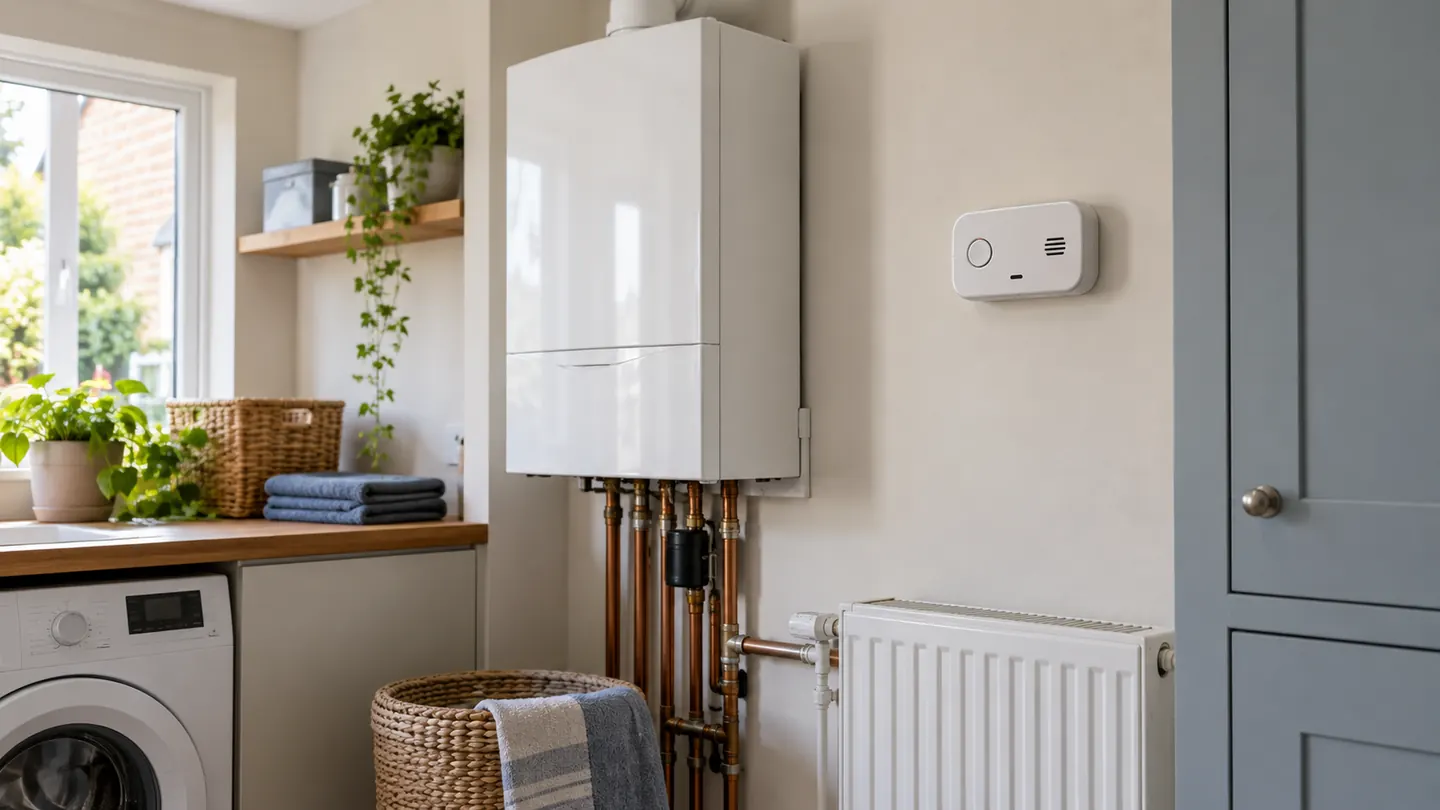
Do not put the alarm inside a boiler cupboard, cover it, or guess a position from a photograph. Room layout and alarm design matter. The instructions supplied with the alarm take priority; if they are missing, use the manufacturer’s current instructions or replace the unit with one whose positioning requirements you can verify.
An alarm is an extra warning, not proof that the boiler is safe. HSE says it must not replace correct installation, maintenance and safety checks by a competent Gas Safe registered engineer.
Why a gas boiler can produce carbon monoxide
Carbon monoxide, or CO, is a poisonous gas made when fuels do not burn properly. You cannot see, smell or taste it. A poorly installed, faulty or badly maintained boiler can produce CO, as can gas fires, cookers and other fuel-burning appliances. A blocked or damaged flue and inadequate ventilation can also allow dangerous gas to build up.
Warning signs around an appliance can include soot or staining, a pilot light that repeatedly goes out, unusual condensation, or a flame that looks different from normal. Do not use those signs as a home test: modern room-sealed boilers may give little visible warning. If you are concerned, stop using the appliance if it is safe to do so and arrange a professional check.
Choose a suitable carbon monoxide alarm
Look for an audible domestic alarm that states it complies with BS EN 50291 and carries a recognised British or European approval mark. Check whether it is intended for the type of home and location you have. A digital display can show a reading or history on some models, but the loud audible warning and compliance marking matter more than extra features.
Read the manufacturing date, replace-by date and battery arrangement. Some sealed-battery alarms are designed to last for the working life of the sensor; replaceable-battery models still need the whole unit replaced when the sensor reaches end of life. A low-battery chirp, fault signal and full CO alarm can sound different, so keep the instructions where the household can find them.
- Standard: BS EN 50291 should be stated on the alarm or packaging.
- Sound: choose an audible alarm that can be heard from sleeping areas.
- Lifetime: record the replace-by date rather than relying on memory.
- Accessibility: consider a specialist linked, vibrating or visual alert if someone may not hear a standard alarm.
Where should a carbon monoxide alarm go near a boiler?
Start with the alarm manufacturer’s instructions. They specify suitable wall or ceiling positions, distances from a fuel-burning appliance and locations to avoid. Scottish statutory guidance gives a useful illustration: unless a manufacturer says otherwise, a wall alarm is positioned high in the room, above doors and windows, while a ceiling alarm is kept away from walls. It advises placing an alarm outside a small boiler cupboard, normally within one to three metres of the appliance. That is context, not a substitute for your own model’s instructions.
Keep the sensor open to the room. Do not put it in a cupboard, behind a curtain or furniture, next to a window, door, extractor fan or air vent, directly above a sink, or where steam, dirt, dust or extreme temperatures could affect it. Do not move an alarm into a hallway merely to make it less visible if the instructions require it in the boiler room.
A boiler in a loft, integral garage, bedroom or open-plan space may need different positioning or an additional alarm. Follow the product instructions and seek advice from a competent installer if the layout is unclear. Never attach an alarm to the boiler casing or interfere with the boiler, flue or ventilation.
Test the alarm and keep the boiler safe
Use the test button at the interval stated in the instructions and after a long absence. The button checks the alarm’s electronics and sounder; it does not test the boiler or prove the room is free of CO. Do not test an alarm with exhaust fumes, smoke or a flame. Keep vents clear, do not paint the alarm, and replace it if it is damaged, faulty or past its expiry date.
Have gas work carried out only by an engineer who is Gas Safe registered and qualified for that appliance. If you rent, the landlord normally has responsibility for supplied gas appliances and annual gas safety checks. Our boiler service guide explains the difference between routine servicing and a landlord gas safety check.
What to do if the carbon monoxide alarm sounds
Treat a full CO alarm as real. Stop using suspected appliances if you can do so without delay or risk, go outside into fresh air, and do not return until you have obtained advice. Do not remove the battery, silence the unit and carry on using the boiler.
The NHS says to call 111 if you think you have symptoms of carbon monoxide poisoning. Call 999 or go to A&E for severe signs such as difficulty breathing, sudden confusion, loss of consciousness, weakness, or chest or muscle pain. Do not drive yourself to A&E. Symptoms can include headache, dizziness, nausea, tiredness and confusion, and may improve after leaving the building.
If you think a gas appliance is leaking carbon monoxide, call 0800 111 999 in Great Britain. In Northern Ireland, call 0800 002 001. Follow the call handler’s instructions and arrange for the appliance to be checked before it is used again. Our gas emergency guide explains why a gas smell and odourless CO are different warnings.
Rules for rented homes differ across the UK
In England, relevant private and social landlords must provide a CO alarm in any room used as living accommodation that contains a fixed combustion appliance, except a gas cooker. They must ensure required alarms work at the start of a new tenancy and repair or replace a reported faulty alarm as soon as reasonably practicable.
In Wales, a rented home must have a working CO alarm in every room with a gas, oil or solid-fuel-burning appliance. In Scotland, satisfactory CO detection forms part of the Tolerable Standard for all homes, regardless of tenure; the detailed guidance covers rooms with fixed combustion appliances and rooms through which a flue passes. In Northern Ireland, private rented homes must have a CO alarm in any room or circulation space containing a flue or fixed combustion appliance other than a gas cooker or oven; the 2024 regulations apply to all private tenancies.
These are minimum legal duties, not limits on sensible protection. Tenants should report a missing or faulty alarm and any boiler concern in writing, but should not wait for a dispute to be resolved if the alarm sounds or someone feels unwell. Homeowners should apply the same practical safety standard even where a landlord rule does not apply.
| Nation | Practical minimum described by official guidance |
|---|---|
| England | Alarm in a lived-in room with a fixed combustion appliance, excluding a gas cooker |
| Wales | Working alarm in each room with a gas, oil or solid-fuel appliance |
| Scotland | Satisfactory CO detection under the Tolerable Standard; follow detailed siting guidance |
| Northern Ireland | Alarm in a room or circulation space with a flue or fixed combustion appliance, excluding gas cooking |
Rules and enforcement routes differ. Check the linked national guidance for the exact property and tenure.
Keep safety checks separate from bill checks
An unexplained rise in gas use does not by itself prove a CO problem, and a normal bill does not prove that an appliance is safe. Use the gas bill calculator to check meter readings and cost, but use an alarm, professional maintenance and prompt action for safety.
If the concern is a high charge rather than an alarm or symptoms, work through the high gas bill checklist. If there is any sign of immediate danger, leave the property and use the emergency route instead of investigating consumption.
Frequently asked questions
Do I need a carbon monoxide alarm if I have a gas boiler?
Yes. NHS and HSE guidance recommends an audible CO alarm as an additional precaution. Rented-home rules also require alarms in relevant rooms, although the exact legal wording differs across the UK.
How far should a carbon monoxide alarm be from a boiler?
Use the distance and position in the alarm manufacturer’s instructions. Scottish guidance describes one to three metres for an alarm outside a small boiler cupboard unless the manufacturer says otherwise, but layouts and alarm models differ.
Can I put a carbon monoxide alarm inside a boiler cupboard?
Normally no. Guidance says the alarm should be outside a small boiler cupboard so room air can reach it and the sound can be heard. Follow the specific alarm instructions.
How often should I test a carbon monoxide alarm?
Test it at the interval stated by its manufacturer, using the test button, and replace the unit by its end-of-life date. The button tests the alarm, not the boiler or the air.
What should I do if my carbon monoxide alarm beeps?
Identify whether it is the full alarm, a low-battery chirp or a fault signal from the instructions. Treat a full alarm as real: leave for fresh air, seek urgent medical advice if anyone has symptoms, and have the appliance checked before reuse.
Sources
Rates and rules checked on 13 October 2026. Time-sensitive figures should be checked again before use.
- HSE: domestic gas frequently asked questions and CO alarm guidance
- NHS: carbon monoxide poisoning, symptoms and emergency action
- GOV.UK: Smoke and Carbon Monoxide Alarm Regulations guidance for England
- GOV.WALES: carbon monoxide alarms
- Scottish Government: carbon monoxide alarms in private rented properties
- Northern Ireland Department for Communities: 2024 private-tenancy alarm guidance