
At a glance
Before moving day: tell the old supplier
Contact the gas supplier for the home you are leaving and give the date you will stop being responsible for the property. Citizens Advice in England recommends at least 48 hours’ notice. The equivalent advice pages for Scotland, Wales and Northern Ireland should be used where applicable.
Give a forwarding address and a reliable email address. Ask what the supplier needs for a final reading and whether your fixed tariff has an exit fee or can move with you. Do not assume an account follows you automatically: the meter belongs to the property’s supply point, while your contract and responsibility are tied to dates.
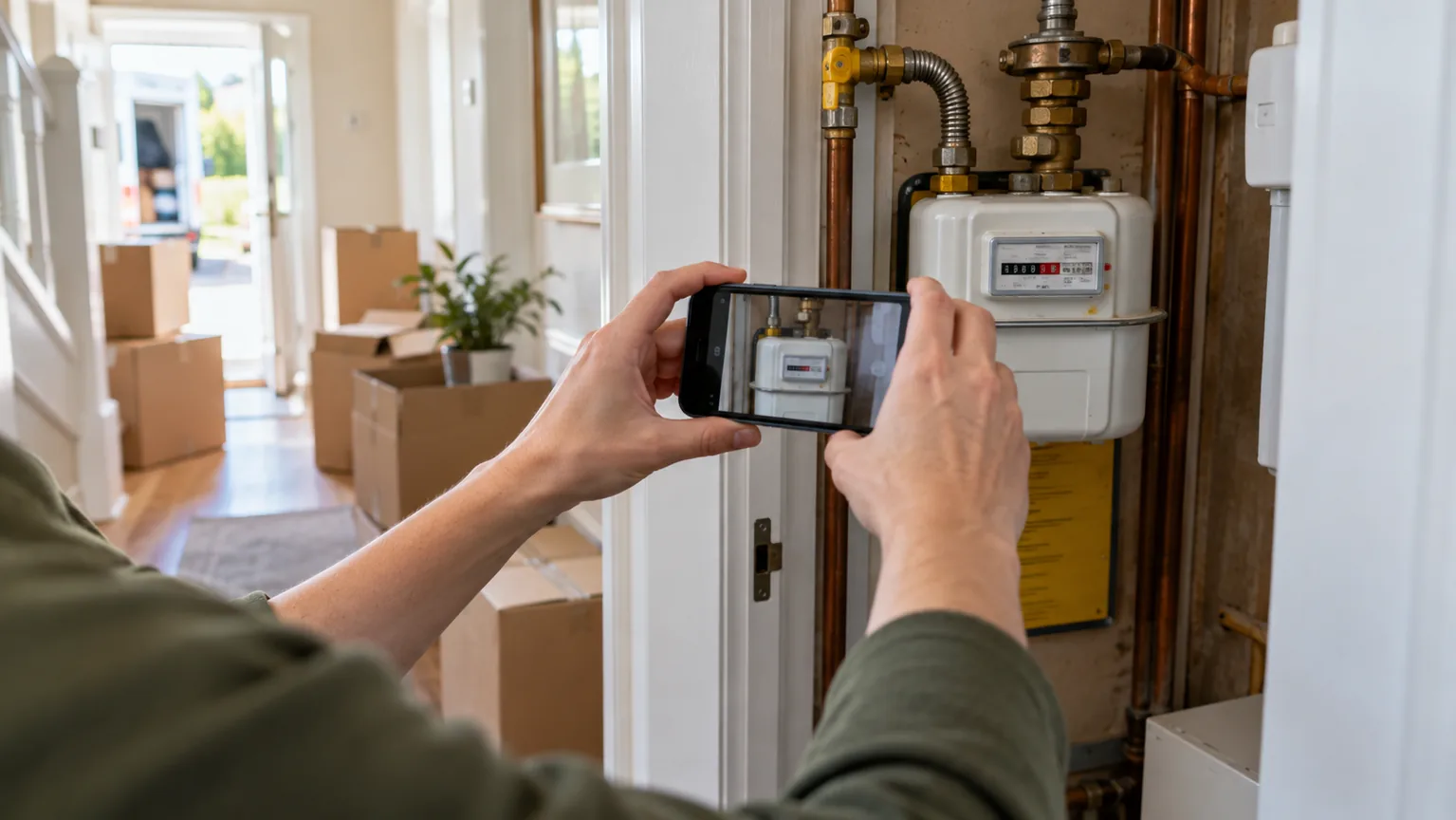
Find the gas meter before the removal van arrives. If it is in a locked communal area or external box, arrange access. Confirm whether it is metric, imperial or smart and locate the meter serial number so your photograph captures the correct device.
At the old home: make the final reading hard to dispute
On the day responsibility ends, take a clear photograph of the fixed meter reading. Keep the original file because its timestamp can support the date. Take a second wider photograph showing the meter in place, and write down the reading rather than relying on the image alone.
Submit the reading to the old supplier and save the confirmation or complaint reference. Do this even with a smart meter. Citizens Advice specifically recommends a manual final reading if the meter is not working in smart mode, and a dated photo remains useful evidence if a transmitted reading is disputed.
Leave the in-home display at the property. It is paired with the metering system and is intended for the next occupier, not as a portable record of your old account.
- Record: gas reading, meter serial number, date and time.
- Submit: reading, move-out date and forwarding address.
- Retain: photographs, submission receipt and the last normal bill.
- Check: whether keys, cards or meter-box access need to stay with the property.
At the new home: start with evidence, not assumptions
Photograph and record the new property’s gas meter as soon as you become responsible for it, ideally before normal heating and hot-water use begins. That opening reading separates your consumption from the previous occupier’s.
Contact the existing supplier at the property and give your name, move-in date and opening reading. Until you choose another deal, you will normally be on a deemed contract with that supplier. It is usually a default or standard variable tariff, so ask for the unit rate and standing charge rather than waiting for the first bill.
If you do not know the gas supplier, Ofgem points customers to the Meter Point Administration Service’s Find My Supplier service. It can also provide the Meter Point Reference Number (MPRN), the identifier for the property’s gas supply point.
Extra care with prepayment and smart meters
If the new home has a prepayment meter, contact the existing supplier before using the previous occupier’s key or card or adding credit if you can avoid it. Citizens Advice warns that you could otherwise pay towards someone else’s debt. Ask the supplier to remove old debt from the meter and issue the correct key, card or account setup.
A smart meter may not immediately operate in smart mode after an account or supplier change. Take the physical meter reading anyway. Do not rely on the in-home display as your only record; it is a display, not the legal meter reading source.
If there is no gas supply, distinguish an account or prepayment problem from a physical connection issue. Contact the supplier first. If you smell gas, use the emergency number—0800 111 999 in Great Britain—rather than trying to restore the supply yourself.
Check the final bill instead of filing it unopened
Citizens Advice says the old supplier should send a final bill within six weeks. Match its closing reading and responsibility date to your records. Then check the tariff rates, standing-charge days, payments and whether the account ends in debit or credit.
If the account is in credit, the supplier should refund it. Citizens Advice says the refund should be made within 10 working days of sending the final bill and that a supplier may owe compensation if either deadline is missed.
Keep the bill, photographs and proof of submission until the balance and any refund are settled. If the reading is wrong, challenge it with the dated evidence before a small discrepancy becomes a debt-collection problem.
| Record | Old home | New home |
|---|---|---|
| Responsibility date | Move-out or tenancy-end date | Move-in or tenancy-start date |
| Gas meter reading | Final whole-number reading | Opening whole-number reading |
| Photograph | Reading and serial number | Reading and serial number |
| Supplier evidence | Closure confirmation | New-account confirmation |
Use the first new bill as a final cross-check
The opening reading on the first bill should match the one you submitted. Check the unit rate, daily standing charge and number of days. If you switched shortly after moving in, you may receive a small bill from the property’s original supplier before the chosen supplier takes over.
Use the gas bill calculator to estimate the period from your opening reading, or see why meter units are converted to kWh. If a smart meter is not sending data, our smart meter troubleshooting guide explains how to keep the account on actual readings.
Moving is busy; energy paperwork feels minor until it goes wrong. Ten careful minutes with each meter gives both suppliers a clean boundary and gives you evidence that is difficult to misunderstand later.
Gas price cap FAQs
Should I take a gas meter reading even if the property has a smart meter?
Yes. A dated final or opening reading is useful evidence, and smart communications may not be working during an account or supplier change.
How do I find the gas supplier at my new home?
Use the Meter Point Administration Service’s Find My Supplier service or contact it for the supplier details and the property’s Meter Point Reference Number.
Can I choose a new supplier before I move in?
You normally need to wait until you become responsible for the property. First register with the existing supplier, then choose another tariff or start a switch.
How long should the old supplier take to send the final bill?
Citizens Advice says it should arrive within six weeks. Keep your closing reading and contact the supplier if it does not arrive.
Should I take the in-home display with me?
No. The display is paired with the metering system at the property and should be left for the next occupier.
Sources
Rates and rules checked on 1 October 2026. Time-sensitive figures should be checked again before use.